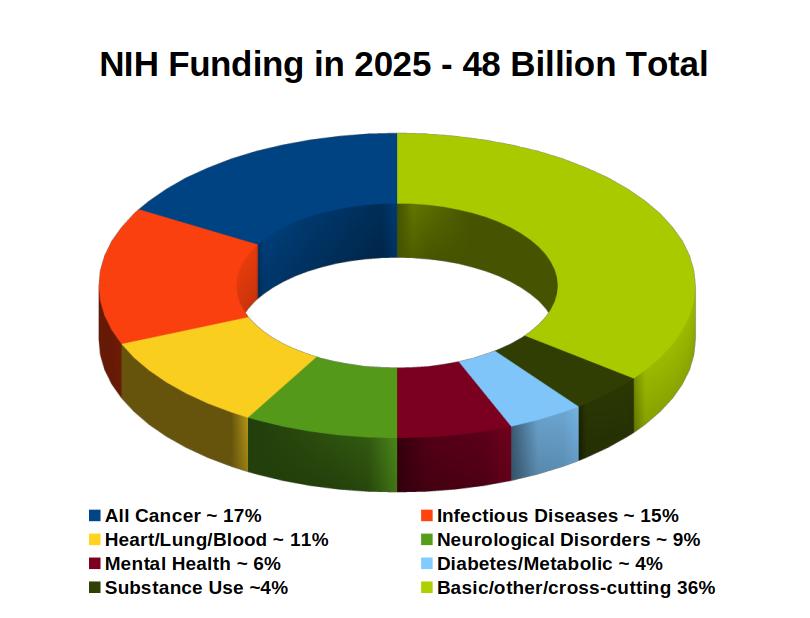
Breakdown of NIH Funding Per General Research Areas
NIH allocated $48 billion for academic research in 2025 (1). The budget remained unchanged since 2024 per Congress’s decision (2). Interestingly enough, the President suggested a $2 billion increase, but it was not implemented (3). The breakdown of research categories provides insight into current trends and, ultimately, highlights the real problems researchers aim to address. From this perspective, it is immediately clear that cancer research leads with 17%, followed by infectious diseases, which is unsurprising given recent events in that field.
When we compare mental health and diabetes funding, we see that mental health research receives 50% more funding than diabetes research. This 50% increase is relative to diabetes, which is categorized together with metabolic diseases research. Alzheimer’s is classified as a neurological disorder. Together with related diseases, it represents the largest research topic within this category. NIH allocated $3.6 billion for Alzheimer’s in 2024. While there is no official data for 2025, it is reasonable to assume that funding has remained within a similar range (5). Therefore, Alzheimer’s alone (with related diseases) accounts for over 80% of the 9% neurological disorder wedge in the chart above.
The mental health wedge in the pie chart is significant, even at 6%. If we combine it with substance abuse, which takes 4%, these two categories together account for 10% of the total research funding. While mental health and substance abuse could be separated from a physiological standpoint, sociologically they are closely linked.
Overall, the chart reflects a relatively generous funding environment with steady growth (5), although funding flattened between 2024 and 2025. Another insight from this chart is, in plain English, somewhat sobering: society continues to face major challenges from cancer, heart-related problems, infectious diseases, mental disorders, substance abuse, and obesity.
Fortunately, not everything is negative. The largest wedge in the pie chart is the basic research and cross-cutting category, which may prove relevant in the future for several of the explicitly listed diseases.
- https://report.nih.gov/funding/categorical-spending
- https://www.aera.net/Newsroom/AERA-Highlights-E-newsletter/AERA-Highlights-March-2025/FY-2025-Wraps-Up-with-Full-Year-Continuing-Resolution-with-Uncertainty-for-Research-and-Statistics-Support
- https://officeofbudget.od.nih.gov/pdfs/FY25/br/Overview of FY 2025 Presidents Budget.pdf
- https://www.ninds.nih.gov/current-research/focus-disorders/focus-alzheimers-disease-and-related-dementias
- https://en.wikipedia.org/wiki/National_Institutes_of_Health